
Our Innovation – Sequential FUE Technique

A “Double Guns” FUE Method for Difficult Graft Extraction

20 Years of Expertise : Every Step Performed in Hong Kong By Doctors

Can surgical technique be adjusted during a difficult FUE procedure?

Yes, and it is often necessary. Standard FUE protocols can fail when follicles are irregularly angled, deeply seated, or embedded in fibrotic tissue. The Sequential Technique provides a real-time, adaptive solution, allowing the surgeon to assess and adjust the depth and angle of extraction on a graft-by-graft basis to maximize yield in difficult zones.

Sara’s comment

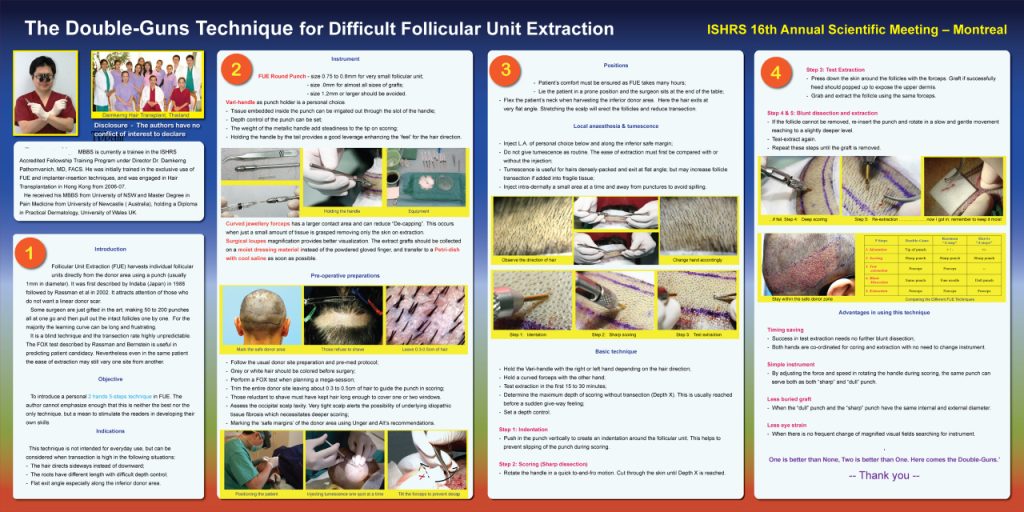
The Sequential FUE Technique (originally the “Double-Gun Technique”) is developed to manage difficult extractions during FUE. Using two hands simultaneously—one to score the graft with a punch and the other to extract it with forceps—it allows for immediate visual feedback and adjustment, minimizing transection in challenging cases. This innovation was formally recognized and named by the ISHRS FUE Committee.

Content-index

Our Double-Gun Technique (2008)

In 2008 we developed a meticulous technique using both hands to extract grafts simultaneously, a reminiscent of its namesake.

  1. Positioning: The surgeon holds a motorized punch in one hand and fine curved forceps in the other.

  2. Sequential Action: The surgeon scores a single graft with the punch, then immediately extracts it with the forceps in the other hand.

  3. Immediate Feedback: The extracted graft is instantly inspected. If transection occurs, the depth and angle are adjusted for the very next graft, allowing for continuous, precise calibration.

When was this innovation recognized by the ISHRS?

  • The ISHRS FUE Committee’s subsequent formal recognition and naming our technique as the “Sequential FUE Technique” validates its clinical utility, and in 2019 formally acknowledged our team as the original developers of this Sequential Follicular Unit Extraction approach.

  • It was later published in Hair Transplant 360 FUE, Drs. Sam Lam & Ken Williams. page 27, First Edition 2016

What problem does the Sequential FUE Technique solve?

  • It addresses the primary intra-operative challenge of FUE: unpredictable graft transection during difficult extractions. In standard FUE, multiple grafts are scored (punched) before extraction.

  • If the depth or angle is incorrect for a particular follicle, multiple grafts can be transected before the error is noticed. Our sequential method eliminates this blind spot.

How is the Sequential ("Double-Gun") Technique performed?

The procedure is a meticulous, two-handed process reminiscent of its namesake.

  1. Positioning: The surgeon holds a motorized punch in one hand and fine curved forceps in the other.

  2. Sequential Action: The surgeon scores a single graft with the punch, then immediately extracts it with the forceps in the other hand.

  3. Immediate Feedback: The extracted graft is instantly inspected. If transection occurs, the depth and angle are adjusted for the very next graft, allowing for continuous, precise calibration.

What are the specific advantages of this method?

Its benefits are most apparent in complex surgical scenarios.

  • Maximizes Yield in Difficult Areas: Drastically reduces transection rates in zones with irregular follicle direction or scarring.

  • Real-Time Surgical Calibration: Provides instant visual feedback, turning each extraction into a learning point for the next.

  • Preservation of Donor Integrity: By preventing buried or transected grafts, it prevents waste and protects the long-term health of the donor area.

When is this technique typically employed?

This is a specialized tool within a broader surgical arsenal, not used for every graft.

  • Primary Use: Managing challenging extractions in areas of high follicular density, irregular angles, or where previous surgery has caused fibrosis.

  • Standard Protocol: For routine, straightforward extractions, we employ our standard FUE-HD protocol for efficiency.

  • Strategic Hybrid Approach: This demonstrates our clinic’s philosophy: mastering multiple techniques allows for adaptive, patient-specific surgery to safeguard every possible graft.

Key Takeaways

  • An Adaptive Surgical Tool: The Sequential FUE Technique is a specialized method for difficult extractions, allowing for graft-by-graft adjustment to minimize transection.

  • Solves a Core FUE Challenge: It addresses the blind spot of standard FUE by providing immediate feedback after each graft is scored, enabling real-time precision calibration.

  • Recognized Innovation: The technique was presented at the ISHRS and formally recognized by its FUE Committee, underscoring its validity.

  • Part of a Broader Mastery: It exemplifies our commitment to mastering multiple advanced techniques to adapt to each patient’s unique surgical landscape, ensuring no graft is needlessly lost.

Interested in a Surgical Plan That Adapts to Your Unique Anatomy?

A successful transplant requires a surgeon equipped with multiple techniques to handle any intra-operative challenge. Discuss how our team’s adaptive approach and technical repertoire can be applied to your case during a consultation. We can detail how we plan to maximize the yield and survival of your valuable donor grafts.

References

  • Standardization of the Terminology Used in FUE : Part II. Hair transplant Forum 2013 Vol 23 No. 6 Nov/Dec pp.210
  • A 2019 Guide to Currently Accepted FUE and Implanter Terminology. Hair transplant Forum 2019 Vol 29 No. 3 May/June pp.102
  • Clarification : FUE Clinical Practice Guidelines. Hair transplant Forum 2019 Vol 29 No. 4 July August/June pp.139-50
  • Lam S. & Williams K. FUE Techniques. Hair Transplant 360 FUE.  2016 First Edition pp. 27
36

MEDICAL - DISCLAIMERS

Images & Information shown are for reference only

Information on this website is provided for general educational purposes only and does not constitute personalized medical advice. It is not intended to promote our service or imply superiority over another.

Individual results in hair restoration vary significantly and no outcome can be guaranteed. The before-and-after images shown represent possible results — not promises. We recommend seeking independent medical advice to discuss your options … Read More

Pre-Consultation Review

Ensure You're a Good Candidate for hair transplant

Why pay for a consultation if you’re not a candidate? Start with our free WhatsApp assessment — the first step in our ‘No-Regret’ protocol to see if hair transplant is a realistic solution for your hair loss.

Still Have Questions ?

If you want to get a personalized answer from our medical team, you can reach us using this form here. We will cantact you as soon as possible.

Our Quality & Safety Standards

Our practice adheres to guidelines established by leading international organizations in Hair Restoration.

ISHRS

International Society of Hair Restoration Surgery is the leading global medical association that establishes international practice standards and patient safety protocols.

ABHRS

The American Board of Hair restoration Surgery represents the highest standard. To maintain rigorous certification requirements the physician must demonstrate surgical expertise.

WFI

Worls FUE InstituteI serves as the premier educational body focused exclusively on Follicular Unit Extraction methodology. The institute ensures consistent application of safe FUE.

This site is registered on wpml.org as a development site. Switch to a production site key to remove this banner.