
Understanding Which Harvesting Technique Is More Suitable For You
Home » FUE or FUT – Which Is Better For You ?
Last Updated: 6 Nov 2025
Hair transplantation has evolved significantly over the past two decades, with two primary techniques dominating the field: Follicular Unit Extraction (FUE) and Follicular Unit Transplantation (FUT), also known as the strip method. Both are well-established, effective procedures for restoring hair in cases of androgenetic alopecia (male- or female-pattern baldness) and other forms of permanent hair loss. However, they differ substantially in technique, recovery, scarring, graft yield, and suitability for different patients. Choosing between them is not a matter of one being universally “better,” but rather which aligns best with your individual anatomy, aesthetic goals, lifestyle, and long-term expectations.

In FUT, a narrow strip of scalp — typically 1–2 cm wide — is surgically removed from the donor area ( usually the mid-back of the head ). This strip is then dissected under microscopes into individual follicular units ( each containing 1–4 hairs ), which are transplanted into the thinning or balding areas. The donor site is closed with sutures or staples, leaving a linear scar.
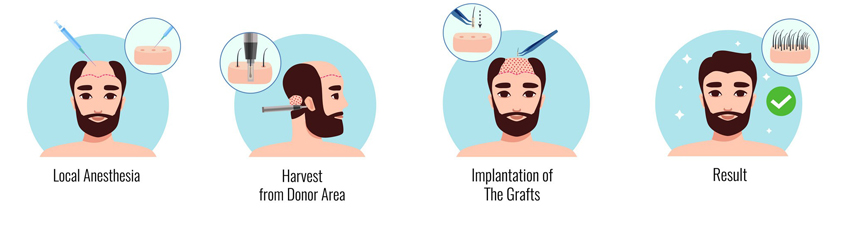
FUE involves extracting individual follicular units directly from the donor area using a small punch tool ( typically 0.7–1.0 mm in diameter ). No strip is removed, and no sutures are needed. The extractions leave tiny, round micro-scars scattered across the donor zone, which are generally invisible unless the hair is cut very short.
FUT : Leaves a single, fine linear scar at the back of the scalp. It’s usually hidden under medium- to long-length hair but becomes visible if the head is shaved or hair is kept very short.
FUE : Produces hundreds to thousands of tiny dot-like scars. These are typically imperceptible with hair as short as 3–5 mm, making FUE preferable for those who wear buzz cuts or fades.
Consideration : If you never plan to shave your head or cut your hair extremely short, FUT scarring may not be a concern. But if short hairstyles are part of your identity, FUE offers greater freedom.
FUT : Involves more post-operative pain and a longer recovery due to the surgical incision. Sutures are usually removed after 10–14 days. Strenuous activity is restricted for 3–4 weeks.
FUE : Generally less painful, with minimal downtime. Most patients resume light activities within a few days and full exercise within 10–14 days.
Note : While FUE is less invasive, it can still cause temporary swelling, numbness, or tightness in the donor area.
FUT : Allows for harvesting a large number of grafts ( 2,500 – 4,000+ ) in a single session with high efficiency and minimal transection ( damage to follicles ).
FUE : Harvesting is more time-consuming and technically demanding. The maximum safe yield per session is often lower ( typically 1,500–2,500 grafts ), though advanced techniques like FUE-HD or robotic FUE can improve consistency.
Implication : Patients needing extensive coverage ( e.g., Norwood VI–VII ) may achieve better density faster with FUT. Those requiring modest restoration may find FUE sufficient.
FUT : Removes a concentrated section of donor tissue permanently. Repeated FUT procedures are rarely possible due to scalp laxity limits and scar accumulation.
FUE : Spreads extractions across a broader area, preserving the option for multiple future sessions — important for younger patients who may experience progressive hair loss over decades.
Strategic point : For patients under 35, FUE is often recommended to conserve donor options for future needs.
Both methods carry low risks when performed by experienced teams. However:
In recent years, many leading clinics have moved away from FUT as a standalone procedure for patients with extensive hair loss, favoring instead a combination (or “combo”) approach that blends FUT and FUE in the same session.
This strategy leverages the high graft yield and efficiency of FUT — ideal for covering large bald areas — while using FUE to harvest additional grafts from regions outside the traditional strip zone ( e.g., sides or nape ) and to camouflage the linear FUT scar by placing follicles directly into it. The combo method maximizes total graft numbers while improving donor-area aesthetics, especially if future short hairstyles are desired.
Pure FUT is now typically reserved for patients who strongly wish to avoid any visible shaving in the donor area ( since FUE requires localized or full donor shaving ), or for those whose scalp anatomy or hair characteristics make FUE less viable. For most others needing dense, large-scale coverage, the combo approach offers a more versatile and future-proof solution.
There is no single “ best ” technique. The optimal choice depends on a careful assessment of :
A reputable hair restoration surgeon will evaluate these factors during consultation — not push one method for financial or marketing reasons — and may even recommend a hybrid approach ( e.g., FUT for the main session, FUE for refinement or crown work ).
Ultimately, success hinges less on the acronym ( FUE vs. FUT ) and more on surgeon skill, realistic planning, and long-term stewardship of your donor supply. Choose a practitioner who prioritizes your lifetime outcome — not just the next procedure.
conditions of use
Information provided on this website is for educational purposes only and is not intended as medical advice. It should not be interpreted as promotional material or as claims of superiority over other techniques or providers.
Individual results may vary, and no outcome can be guaranteed. Always consult with a qualified healthcare professional before making any decisions about medical treatment.
Paragraph
Pre-Consultation Review
If you want to get a personalized answer from our medical team, you can reach us using this form here. We will cantact you as soon as possible.
Our practice adheres to guidelines established by leading international organizations in Hair Restoration.
International Society of Hair Restoration Surgery is the leading global medical association that establishes international practice standards and patient safety protocols.
The American Board of Hair restoration Surgery represents the highest standard. To maintain rigorous certification requirements the physician must demonstrate surgical expertise.
Worls FUE InstituteI serves as the premier educational body focused exclusively on Follicular Unit Extraction methodology. The institute ensures consistent application of safe FUE.