
Androgenetic Alopecia – AGA

The Commonest Cause of Hair Loss in Both Men and Women

Understanding Androgenetic Alopecia

Last Updated: 6 Nov 2025

Androgenetic Alopecia ( AGA ) — commonly known as male- or female-pattern hair loss — is the most prevalent form of progressive hair thinning worldwide. It arises from a combination of genetic predisposition and the effects of androgens, particularly dihydrotestosterone ( DHT ), on susceptible hair follicles.

While AGA typically begins after puberty, its onset, pattern, and pace vary widely between individuals. Crucially, not all hair is equally affected: follicles in the permanent donor zone ( the back and sides of the scalp ) are genetically resistant to DHT and retain their growth characteristics throughout life — making them the foundation of surgical restoration.

Content-index

5 Things You Must Know About AGA

  • Accounts for over 95% of hair loss cases in men and a significant majority in women.
  • Progressive and age-related : Early signs may appear in the 20s, with prevalence increasing steadily through adulthood.
  • Patterned thinning : In men, this usually presents as frontal hairline recessionmid-scalp thinning, or crown (vertex) balding; in women, it often manifests as diffuse central part widening with preserved frontal hairline.
  • Follicle miniaturization — not follicle loss : The total number of follicular openings remains stable, but terminal (thick, pigmented) hairs gradually transform into fine, short, vellus-like hairs under DHT influence.
  • Family history may be absent : While genetics play a key role, AGA can occur even without a strong family history due to complex polygenic inheritance.

The Miniaturization Process : What’s Happening Under the Skin

Miniaturization is the hallmark of AGA:

  • DHT binds to receptors in genetically vulnerable follicles, shortening the anagen (growth) phase.
  • Over successive cycles, hair shafts become progressively finer and shorter.
  • Eventually, they may become nearly invisible—but the follicle often remains alive, offering a window for medical intervention.

This process is reversible in early stages with appropriate treatment, which is why timely diagnosis is critical.

AGA Hair Loss Classification

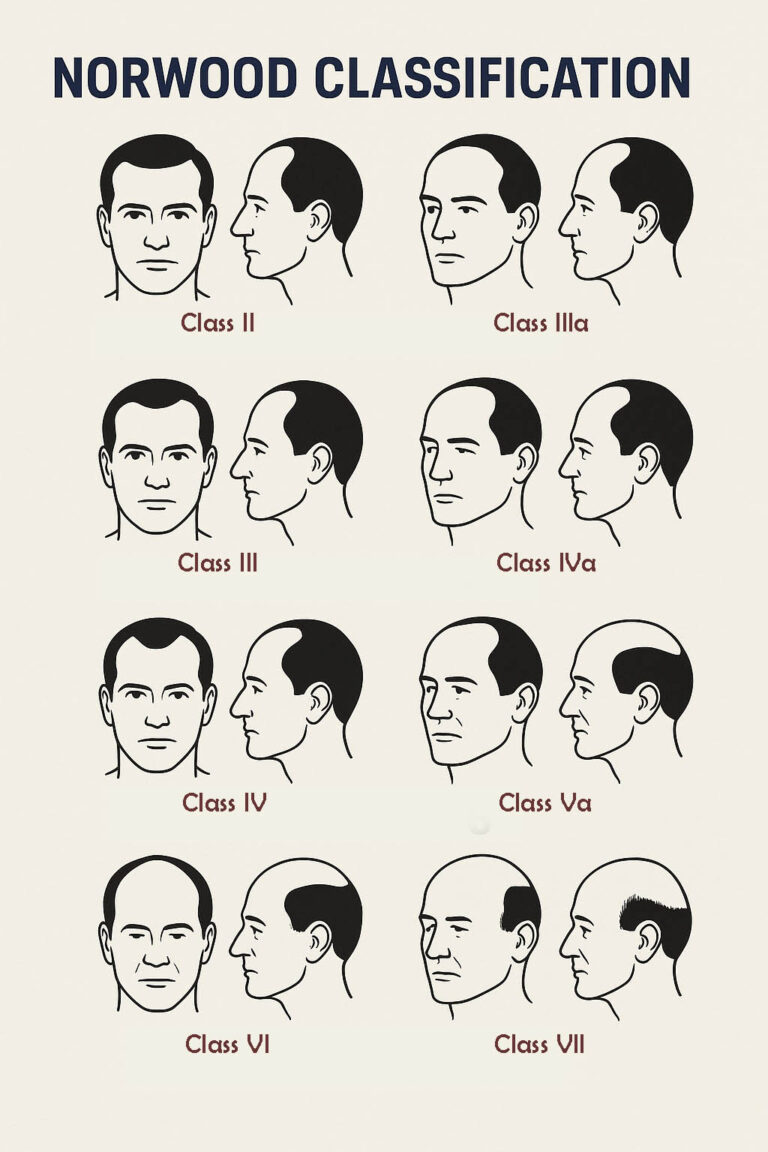
1. Men

The universal standard of MPB (Male Pattern Baldness) categorization was described by Dr Norwood in 1975 – the Norwood Classification. However after seeing thousands of cases, we found that many patients do not actually fit into the types.

Women can have Male Pattern Baldness which is typically the receding of hairline into a M-shape. The Norwood system should be used as guideline only.

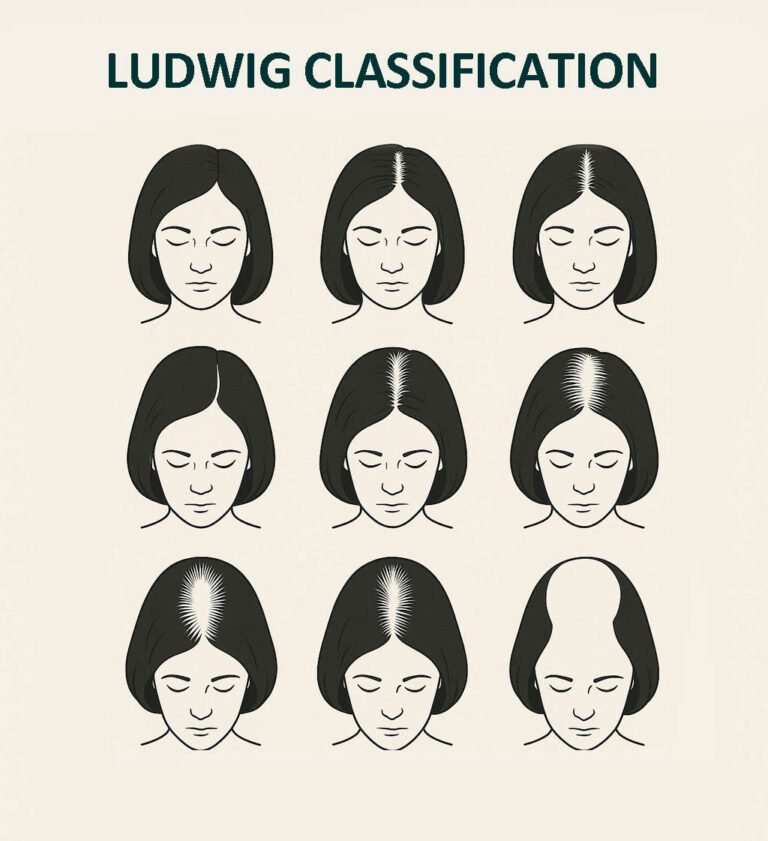
2. Women

Female Pattern Hair Loss (FPHL) has 3 major patterns of hair loss: 

Type 1.  M-Shaped or high forehead 
Type 2.  Thinning at the centerline, extending sidway 
Type 3.  Christmas Tree Pattern – wide in front narrowing down towards crown

Diagnosis : Beyond Pattern Recognition

At Dr. Bertram Hair Transplant, we go beyond visual assessment to confirm AGA and rule out mimics ( e.g., telogen effluvium, scarring alopecias ):

  • Detailed medical & family history
  • Scalp dermoscopy: To quantify the terminal-to-vellus hair ratio and detect early miniaturization before it’s visible to the naked eye.
  • Hair pull test: To assess shedding activity and differentiate AGA from other conditions.
  • Phototrichogram or digital scalp mapping ( when indicated  ): For objective baseline tracking of density and progression.


In select cases, blood work or biopsy may be used to exclude contributing factors like thyroid dysfunction, iron deficiency, or hormonal imbalances.

Heart Diseases Linked to AGA

Emerging research suggests associations between early-onset or vertex-predominant AGA and metabolic or cardiovascular risk factors ( e.g., insulin resistance, hypertension ). While causation isn’t proven, we view hair loss as part of your overall health picture — and encourage comprehensive wellness screening as part of responsible care.

Evidence-Based Treatment Approaches

There is no one-size-fits-all solution for AGA. At our clinic, we tailor strategies based on stage, pattern, age, goals, and long-term vision. Our five-pillar framework includes:

1. Medical Therapies ( Require ongoing use )

  • opical minoxidil : Stimulates follicles and prolongs anagen phase.
  • Oral finasteride/dutasteride ( for men ) : Reduces DHT production; proven to halt progression and regrow hair in many cases.
  • Anti-androgens ( e.g., spironolactone for women ) : Used off-label under specialist supervision.

⚠️ Effects reverse within 6–12 months of discontinuation.

2. Low-Level Laser Therapy (LLLT)

  • FDA-cleared devices that may improve microcirculation and cellular energy in follicles.
  • Best used as an adjunct, not a standalone solution.

3. Scalp Micropigmentation (SMP)

  • A cosmetic tattooing technique that creates the illusion of shaved hair or increased density.
  • Ideal for those seeking non-surgical camouflage or enhancing transplant results.

4. Camouflage & Cover-Up

  • Fibers, sprays, wigs, and hair integration systems offer immediate—but temporary—coverage.
  • Useful during medical treatment lag time or for patients not yet ready for surgery.

5. Hair Transplant ( Permanent )

  • The only permanent solution : relocating DHT-resistant donor follicles to thinning areas.
  • At Dr. Bertram, we emphasize strategic graft placement and lifetime donor preservation — never maximal extraction.
  • Best outcomes occur when surgery is timed after medical stabilization and integrated into a long-term plan.

Our “No Regret” Philosophy in AGA Management

We believe the best hair restoration journey begins with honest diagnosis, realistic expectations, and a lifetime perspective.

For younger patients, this often means starting with medical therapy to slow loss and preserve options. For others, a carefully planned transplant—performed only when the pattern has stabilized — delivers natural, enduring results.

Because at Dr. Bertram Hair Transplant, success isn’t just about how you look today — it’s about how you’ll feel ten, twenty, or thirty years from now.

36

conditions of use

Medical Disclaimers

Information provided on this website is for educational purposes only and is not intended as medical advice. It should not be interpreted as promotional material or as claims of superiority over other techniques or providers.

Individual results may vary, and no outcome can be guaranteed. Always consult with a qualified healthcare professional before making any decisions about medical treatment.

Pre-Consultation Review

Ensure You're a Good Candidate for FUE hair transplant

Why pay for a consultation if you’re not a candidate? Start with our free WhatsApp assessment — the first step in our ‘No-Regret’ protocol to see if hair transplant is a realistic solution for your hair loss.

Still Have Questions ?

If you want to get a personalized answer from our medical team, you can reach us using this form here. We will cantact you as soon as possible.

Our ‘No Regret’ Safety & Precision Protocol

At Dr. Bertram Hair Transplant, we only offer what aligns with natural results, minimal risk, and realistic expectations. Since 2009, our FUE protocols are in strict accordance with evidence-based guidelines from ISHRS and WFI. Every procedure is internally audited against ABHRS surgical benchmarks.

ISHRS

International Society of Hair Restoration Surgery is the leading global medical association that establishes international practice standards and patient safety protocols.

ABHRS

The American Board of Hair restoration Surgery represents the highest standard. To maintain rigorous certification requirements the physician must demonstrate surgical expertise.

WFI

Worls FUE InstituteI serves as the premier educational body focused exclusively on Follicular Unit Extraction methodology. The institute ensures consistent application of safe FUE.

This site is registered on wpml.org as a development site. Switch to a production site key to remove this banner.